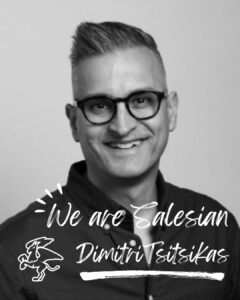
From student to parent, Dimitri Tsitsikas connection with Salesian College Chadstone has come full circle. After graduating in 1994, his journey has been shaped by a strong sense of purpose, leadership and a commitment to creating opportunities for others.
In this interview, Dimitri reflects on returning to the College through the eyes of a parent, the experiences that shaped his approach to leadership and the values that continue to guide his work. He also shares the inspiration behind his involvement with It’s Philanthropy, an initiative focused on supporting educational projects in some of the world’s most disadvantaged communities, and speaks about the role education plays in building a fairer and more hopeful future.
You graduated from Salesian in 1994 and are now a parent at the College. How does it feel to see the school through a different lens all these years later?
It is very special, and I am genuinely pleased to now see the school from a different perspective. As a student you are focused on your own world at the time, your friends and simply finding your way. Coming back now as a parent, I see much more clearly the role the College plays in shaping young people, not only academically but also in character, values and confidence.
What stands out to me now is the sense of community and the importance of helping young people believe in themselves. That is something I appreciate more deeply with time. You realise education is not only about learning subjects. It is also about helping form the person you become.
Your professional journey has evolved over time, but a clear thread is purpose driven leadership. What experiences most shaped your approach to work and impact?
Much of it has come through life experience. Over time I came to understand that success on its own can feel incomplete if it is not connected to something meaningful. The experiences that shaped me most were those that involved building something, helping others grow and creating opportunities that had a positive impact beyond myself.
That has become an important part of how I think about leadership. For me, leadership is not only about results or achievement. It is about creating the conditions for others to thrive. Whether that is in business, family life or philanthropy, the most meaningful work is the work that helps people see a better future for themselves and gives them the chance to move towards it.
You are involved in It’s Philanthropy, which focuses on funding educational projects in some of the world’s poorest communities. What motivated you to become part of that mission?
I have always believed education can change the direction of someone’s life. When you see communities where access to schooling is limited or simply not available, it really puts many things into perspective.
One of the reasons for launching It’s Philanthropy was the belief that learning and opportunity can shift everything. When a child learns to read, when they have a safe place to learn, and when they feel supported and encouraged, it can completely change how they see themselves and their future. I was drawn to this mission because it is about creating real change, not in an abstract way, but in a very human and practical one.
To begin this project and be supported by family and friends in something that helps give children hope, dignity and opportunity is incredibly meaningful. It reminds you that even what may seem like a small contribution can have a lasting impact when it is directed in the right way.
It’s Philanthropy speaks about creating a fairer and more equal world through education. In practical terms, what does that look like on the ground?
On the ground it looks very practical and very real. It can mean classrooms being built, children having books and school chairs, teachers being supported, or students receiving a meal at school so they can concentrate and learn. These things may sound simple, but they are often the building blocks of transformation.
What I find powerful is that it is not just about providing something in the moment. It is about creating the conditions for long term change. A book, a teacher, a classroom or a meal are not just resources. They are opportunities. They give a child a better chance to define a different future for themselves.
That is what creating a fairer and more equal world looks like in practical terms. It is helping communities build from the ground up through education, one child, one family and one village at a time.
How do you balance professional ambition with a commitment to social impact and giving back?
For me, the two are closely connected. Professional ambition matters because it gives you the ability to build, to grow and to support your family. Giving back gives that ambition a deeper purpose.
What I value about It’s Philanthropy is that it is not simply about aid for the sake of aid. It is about empowerment and self sufficiency. Education is one of the clearest ways to help create that. When children are given access to learning, they are better equipped to shape their own lives, support their families and strengthen their communities over time.
As life goes on, you begin to realise that achievement means more when it is connected to contribution. It is not only about what you create for yourself, but also what you can help create for others.
When you reflect on your time at Salesian, were there particular values, mentors or experiences that influenced your sense of responsibility to others?
Yes, definitely. The sense of community was always strong, and there was a clear emphasis on respect, humility and care for others. There were teachers and mentors who genuinely invested in students, and that leaves a lasting impression.
Looking back, those values shaped more of my thinking than I probably realised at the time. They helped form the belief that whatever success looks like, it should come with a sense of responsibility. You do not move through life alone, and you do not succeed alone. At some point you begin to understand that part of living well is using your opportunities in a way that can also benefit others.
As someone who has built a career, supported a family and invested in philanthropy, what advice would you give to current students about defining success in a meaningful way?
I would say not to define success too narrowly. Of course it is important to work hard, aim high and make the most of your opportunities, but success is about more than titles, money or recognition.
Real success is about the kind of person you become, how you treat people, the relationships you build and whether you use your life to make a positive difference. Sometimes the difference between opportunity and disadvantage is something as simple as access to education, support or encouragement. If you are fortunate enough to receive those things, it is worth thinking about how you can help create them for others.
Work hard, stay grounded and try to build a life that reflects your values. That, to me, is a very meaningful kind of success.